Thursday, August 4, 2011
Why Are the Greens Slower In the Summer?
Everyone has to remember, bentgrass and poa annua are cool season grasses. The OPTIMAL temperature fot cool season grasses is 60-75F. July our average temperature was 82. With the ocean being so warm, the nighttime temperatures averaged 73 for July. Combine this with almost 6 iinches of rain, the cool season grasses thin out. Remember, the grass cannot go inside to the air conditioning. The grass also undergoes a phisiological change when it is hot. The plant swells as a survival mechanism. I also observe not as clean of a cut during hot weather. We do everything to protect the turf. Being new, I have opted for a turf health approach to managment. On July 8, the USGA issued a regional advisory. I will post some of these going forward. The long term outlook was for hot weather. They advised raising mowing heights and changing the greens rollers from grooved to solid rollers as a pro-active approach. We made the decision to raise the height by .005 inch on both golf courses. We opted to protect Seaside greens, due to their construction by raising another .005 this week. Solid rollers were put on the greens mowers. Today, we put them on Newport. What is the difference? Take a look at the picture. The roller on the left is a Wiele or grooved roller. The grooves pinch the grass and stand it up for a more aggressive cut. The right roller is a traditional smooth roller. The ones we are using are 20 pounds. The smooth roller being less aggressive, helps further thinning of greens. You will notice most of the thinning greens have a lot of trees around them. It does not take much to tip the scales in a negative direction. We utilize a spray program of various growth regulators, fertilizers, fungicides, insecticides and biostimulants. One wrong mix spells disaster. The weekly spoon feeding of fertilizer products help manipulate the plant into thinking it is in 75 degree comfort. Think about it. We also treat the greens every two weeks with a soil spray to help prevent our root systems from becoming dysfunctional. Ever see a putting green look very pale or almost white? That is a possible sign of root dysfunction. When the roots cannot absorb water and nutrients, the plants can die rapidly. It truly is a delicate balancing act in summer. While this is the basics, I just want to inform everyone there is more to it than meets the eye. When it is hot and humid, the best things we can do is deal with the slower speeds, understand what we are doing, vent the greens with small aerifier tines and this fall, we will have some of the finest putting surfaces around. In July and August, I definitely manage defensively. Defense wins championships!
What Is the Brown Spot on the Front of #15 Green Newport?
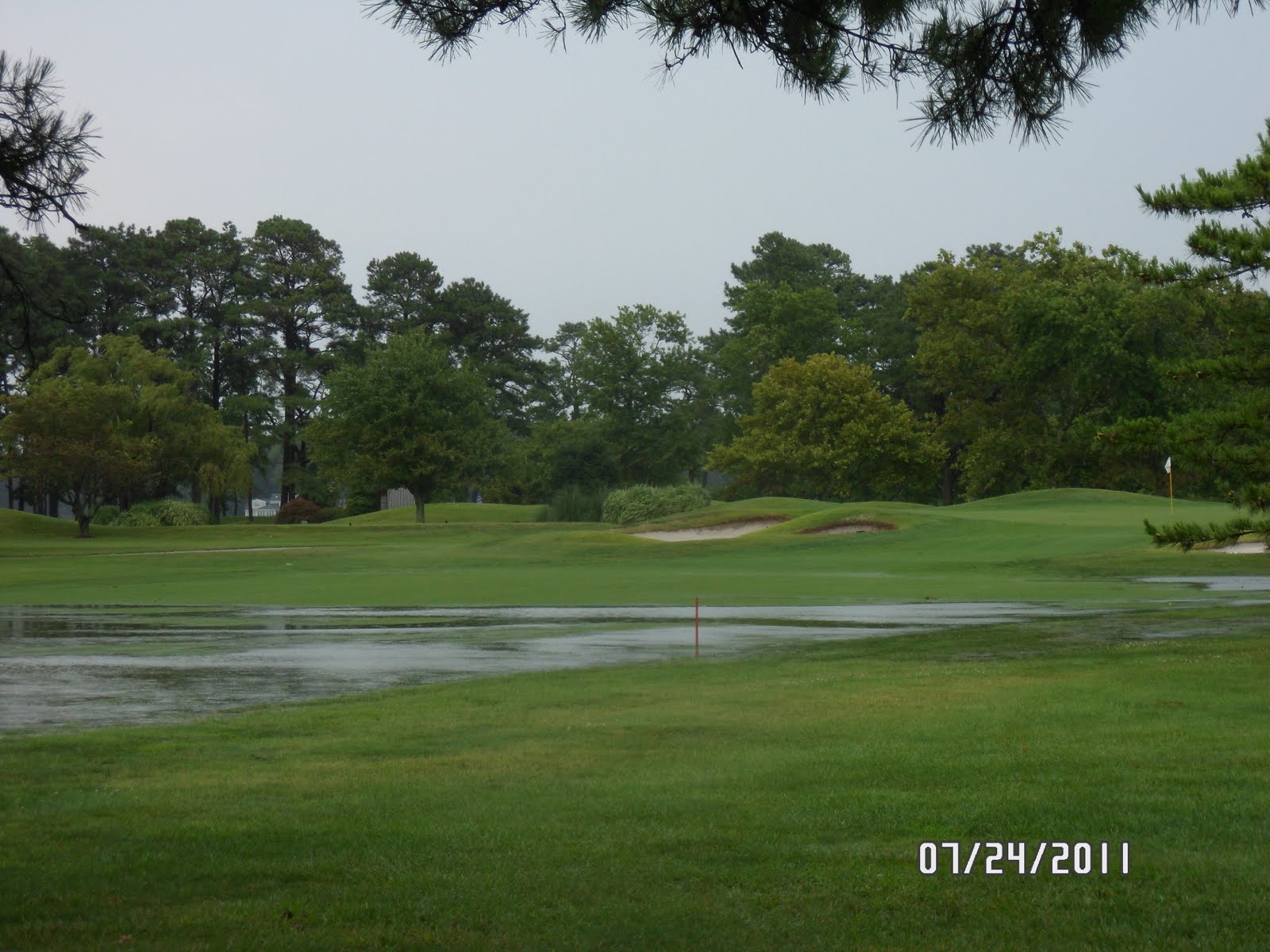
If you notice, the front right of the green is the lowest point. After the storm of the 24th which dumped 2.25 inches of rain on OCGC, the hot temperatures caused a phenomenon known as "WET WILT". Wet wilt occurs during hot, humid weather, generally after a rain event. The soil is saturated from the rain. There is no oxygen in the root zone for the green. It literally boils the root system. Obviously, a syringe of water won't make it bounce back. The only option is to vent the area with aerification holes. The hope is the holes allow the soils to dry out and if there is any good root system left, it will regenerate. Many people have asked if I am glad we have received a lot of rain lately. In July and August, my answer is NO! Turf quality is much better if we can control the water in the summer.
Clean Up Almost Done
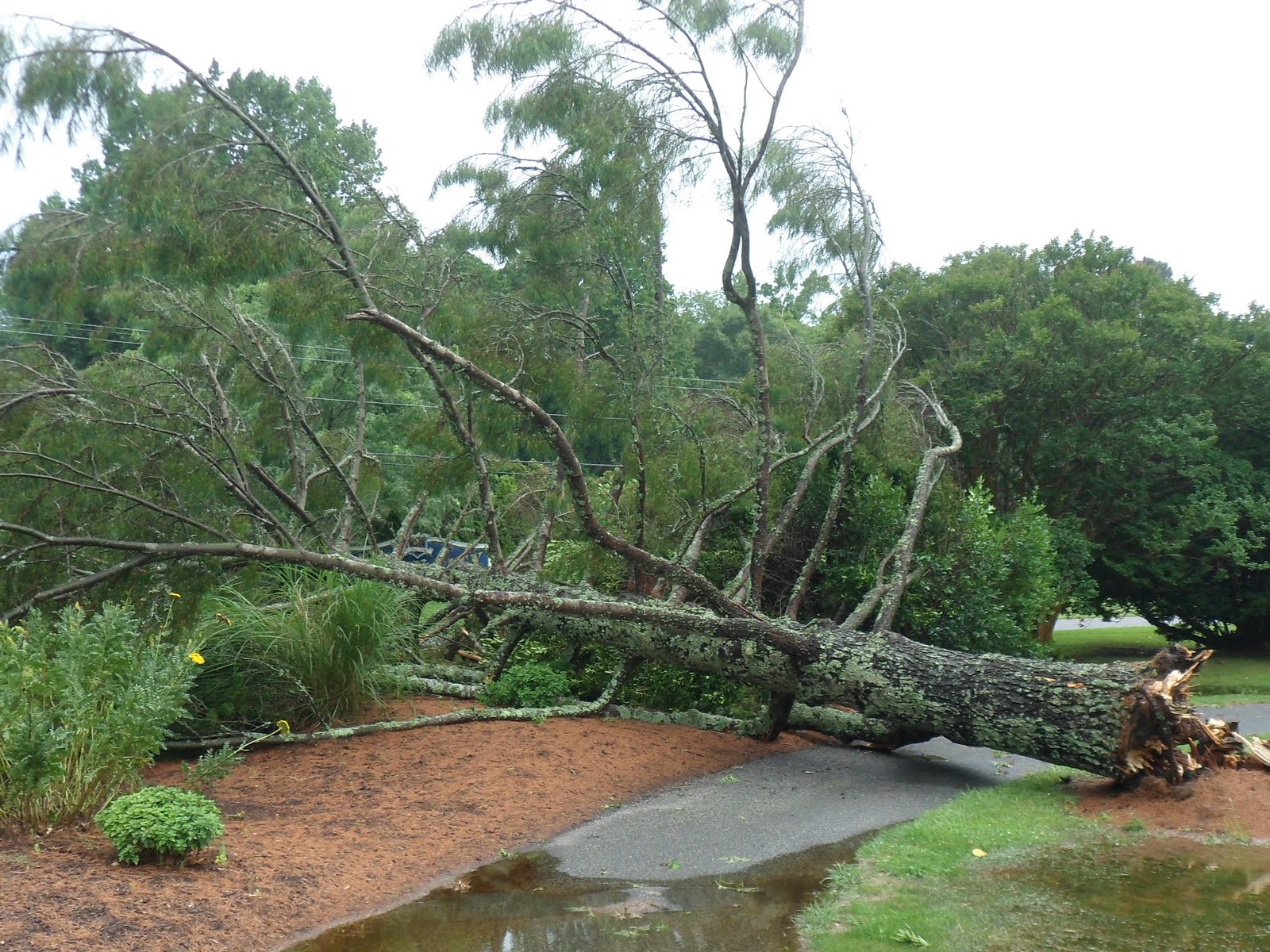
This is our maintenance staff at OCGC. These guys worked really hard to clean up the debris from July 24th microburst thunderstorm. The huge pile behind them is at the back of the driving range. In all 20 trees were downed and countless other branches were snapped. It was a storm I won't soon forget.
Sunday, July 24, 2011
Thursday, July 21, 2011
Managing Greens in Hot, Humid Weather
The picture above shows turf thinning on #15 green Seaside. This is not uncommon in traffic areas on greens during very hot, humid weather. The soil based greens on Seaside are MORE susceptible to thinning. Things we do to help the greens survive are: we aerified the greens BEFORE this weather event with 1/4" solid tines to release carbon dioxide from the root zones and let fresh oxygen into the soil. We read a USGA recommendation and raised mowing height by .005 inch. We also will use solid rollers on the greens mowers. The rollers we use most of the year are grooved. The grooves stand the grass up allowing for a cleaner cut. The grooved rollers put a lot of mechanical stress on the greens. Until the weather cools for the summer, we have put smooth 19 pound rollers on the Seaside greens mowers. We have to give the soil greens every advantage to survive the harsh conditions. We take a long term approach to management. It is easy to maintain the same way during stressful weather. We are trying to be proactive. Smoothness will not suffer, but the speeds won't be what everyone would like. In addition, the bentgrass and poa annua "puffs up" during extreme heat as a defense mechanism. If the height was to be maintained at the original level, the greens would scalp and be severely damaged. We have to be very careful with our chemical and fertilizer selections. So now you have a little glimse of what we face when maintaining your playing conditions. We also try to see problems before they become problems.
Monday, July 18, 2011
Newport Fairways Update
I think we all can agree the fairways on Newport Bay are dramatically improved. In addition to the increased granular fertilizer applications, we have been spraying feed grade urea weekly. With the lower mowing heights and increase in fertilizer, we are encouraging bermudagrass growth. Most of the larger areas we sprayed with Revolver (killing the poa annua and ryegrass) are filling in. We are in the process of plugging and sand topdressing the weakest areas. The above picture shows bermudagrass filling in a spot previously occupied with poa annua. Remember the only fairways we did NOT spray are 18, 17, 13, 11, 8 and the right of 5. Some of these areas will likely be sprigged in the worst areas next year. Our goal is to have some of the finest bermudagrass fairways in the area within the next 2-3 years.
Sunday, July 17, 2011
Why So Much Green Dye?
We use two types of green dye when spraying greens. On the right is TRACKER. We use 16 oz per acre. Tracker indicates where we have sprayed and avoids costly overlaps and misapplications. We also can see if a spray nozzle is clogged. Tracker is a necessary evil. I'm sorry it does create some problems for early players when we spray. We try to spray with enough time for sufficent drying.
On the left is a product introduced a few years back, but was introduced last year as a stand alone product PAR. PAR is actually a stressguard for the greens. We use 16 oz per acre every two weeks. PAR is like spraying SPF 50 on the turf.
The dye is usually gone the next day through mowing or irrigation. The PAR once dry on the plant, lasts two weeks.
I hope this explaination is helpful.
On the left is a product introduced a few years back, but was introduced last year as a stand alone product PAR. PAR is actually a stressguard for the greens. We use 16 oz per acre every two weeks. PAR is like spraying SPF 50 on the turf.
The dye is usually gone the next day through mowing or irrigation. The PAR once dry on the plant, lasts two weeks.
I hope this explaination is helpful.
Subscribe to:
Posts (Atom)